Three Short Speaking Rounds for More Purposeful Language Practice
Oct 24 2026
A conversation exercise can be difficult to start when the instruction is simply “talk about your weekend.” One learner may run out of ideas after a sentence while another speaks for most of the activity. Clear prompts and short rounds give both partners a more concrete job.
A tutor can use a browser toolkit such as ClockFresh to make the timing visible while keeping the lesson materials separate. The timer is there to organise turns, not to rate fluency or decide whether a learner's answer is good.
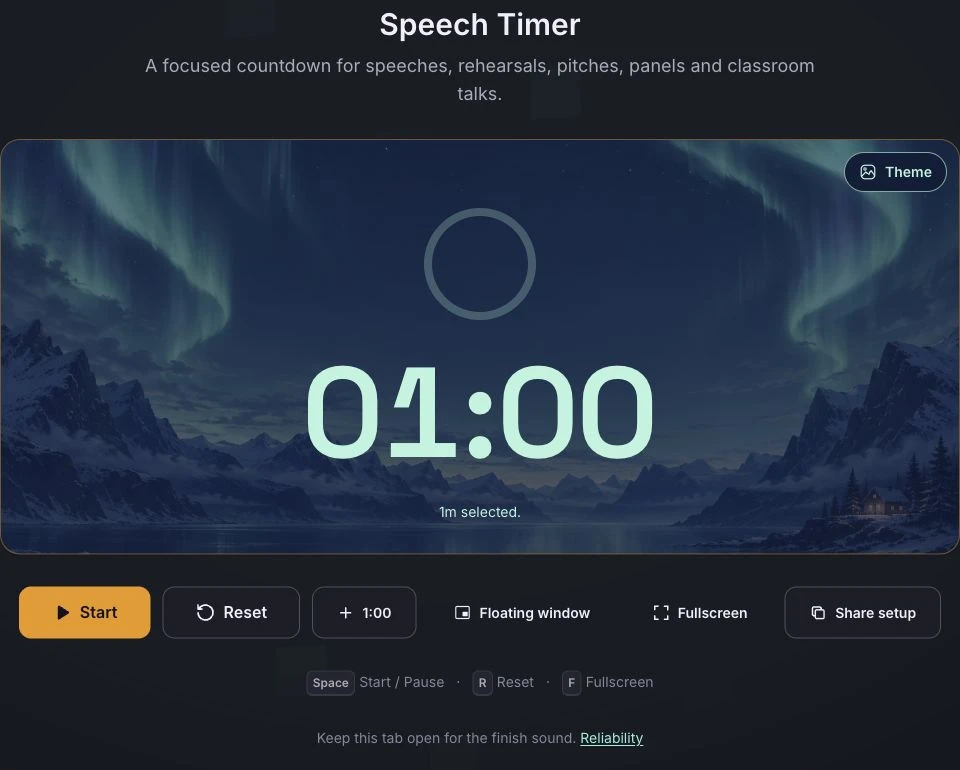
ClockFresh interface screenshot: a one-minute speaking turn. Adjust the duration to the learner. Image supplied by ClockFresh.
Prepare one prompt and one listening task
Choose a topic that learners can discuss using vocabulary they already know. Instead of a broad theme such as travel, try “describe a place you would show a visitor and give two reasons for choosing it.” For beginners, offer a picture and a few sentence starters.
Give the listener a task as well. They might note the place, the two reasons and one follow-up question. This makes listening part of the activity rather than a wait for their own turn.
Explain the sequence before starting. Learners should know that they will have another opportunity to speak after receiving feedback.
Round one: communicate the main idea
Allow a short preparation period, then invite the first speaker to respond. A speech timer can display the agreed turn length. For an intermediate learner, 60 to 90 seconds may be a useful starting experiment; a beginner might begin with a few sentences and a longer preparation period.
These durations are examples, not proficiency standards. Extend or remove the countdown when it interferes with the learner's ability to participate. The objective is an understandable message, not filling every second.
During the turn, the listener focuses on meaning. Unless a correction is necessary to continue the conversation, save it until the speaker has finished.
Round two: answer a real follow-up question
The listener summarises what they understood and asks their prepared question. The speaker answers without reading a complete script. Then the partners switch roles.
Useful questions often ask for a reason, a comparison or a small detail: “Why would you choose that place over the beach?” is more likely to create a response than “Was it good?” Model one example if the group is unfamiliar with follow-up questions.
A tutor can circulate and note patterns without interrupting every exchange. If several learners struggle with the same phrase, address it between rounds so everyone can use the explanation.
Give feedback that can be used immediately
Ask the listener to identify one clear detail and one point that needed clarification. Keep the feedback specific: “I understood the route, but I did not understand when the museum opens” is easier to act on than “speak better.”
The tutor can select one language feature for attention, such as using past tense consistently or connecting a reason with “because.” Avoid giving a long list of corrections before the learner has another chance to try.
Round three: repeat with one deliberate change
Invite the learner to tell the story or explanation again, this time applying the selected feedback. They can keep the same time allowance. Repeating the task does not need to become a race.
For learners who find a countdown distracting, an unobtrusive online stopwatch lets the tutor observe the approximate turn length without displaying a shrinking deadline. Stop it manually at a natural pause and discuss the content first.
Any timing notes belong to the exercise. They are not a diagnostic test, a speaking score or evidence that a learner has reached a new language level.
Adapt the activity to the person
Offer extra preparation, a visual prompt, a private practice turn or an untimed option when needed. In an online lesson, decide who controls the timer so the student does not need to manage several windows while speaking.
At the end, ask the learner which change made the second explanation clearer. Carry that observation into the next lesson. Short rounds are most useful when they create another chance to communicate, listen and respond with a purpose.
Mar 27 2025
Missoula Teacher Named Finalist for Prestigious Teaching Award
Mar 27 2025
Trump Administration Requests Supreme Court to Halt Teacher Training Grants
Mar 27 2025
Brisk Teaching Secures $6.9 Million Funding and Launches AI Tool for Student Learning
Mar 27 2025
Teaching Fellow Appreciation at Baylor Engineering
Mar 27 2025
Trump Requests Supreme Court to Reinstate Teacher Grants Cancellation
Mar 27 2025